Healthcare AI Workflow
QuickCliniq
WhatsApp-first clinic management for patient intake, scheduling, and operations.
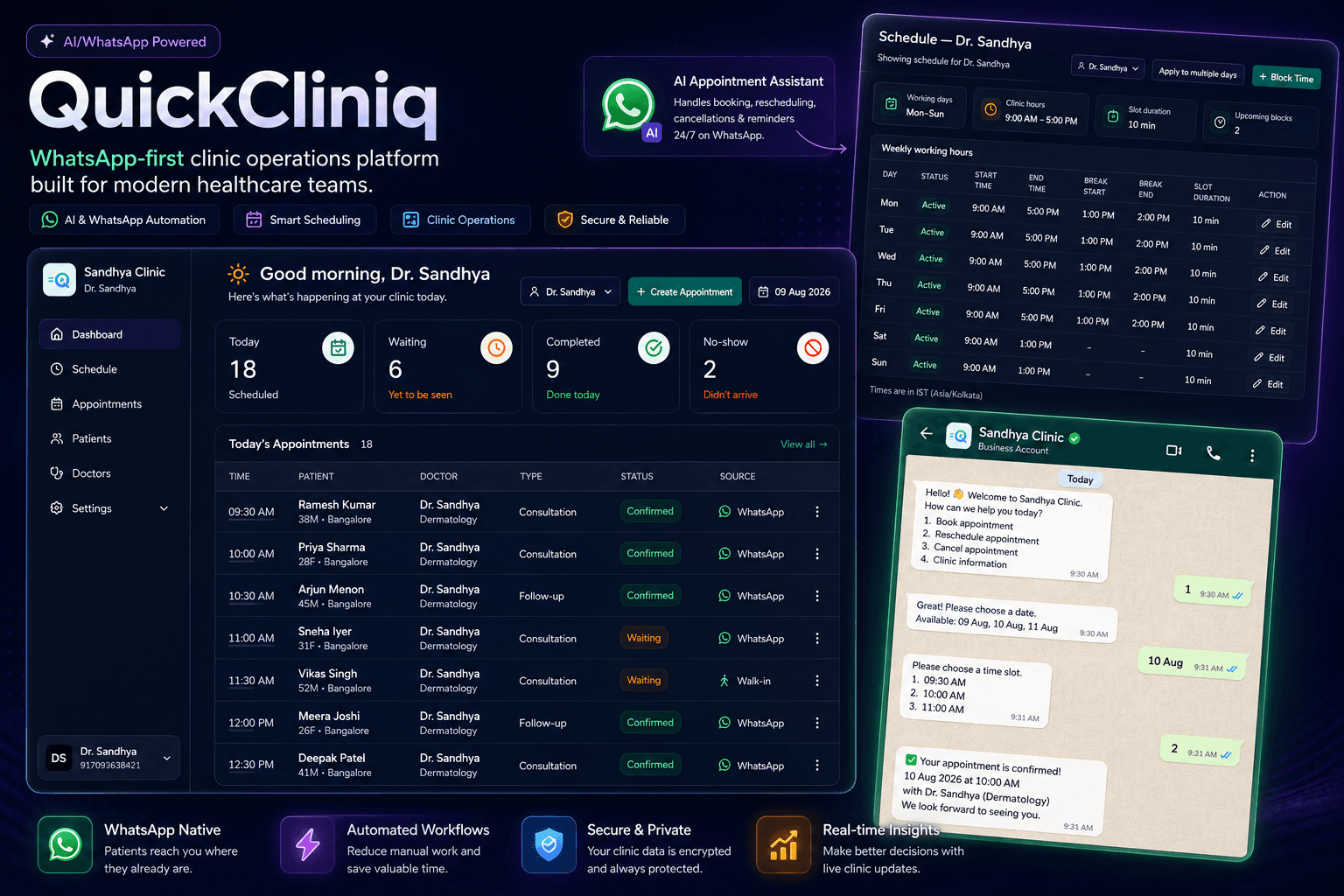
What I Built
A clinic operations platform connecting WhatsApp patient communication with scheduling and clinic workflows.
WhatsApp Appointment Automation
Patients can discover availability, book appointments, reschedule, and receive confirmations directly through WhatsApp.
Patient Communication
Automated confirmations, reminders, and follow-ups designed to reduce manual coordination between patients, doctors, and clinic staff.
Intelligent Scheduling
Availability-aware scheduling handles doctor calendars, slot generation, and booking constraints.
Clinic Operations Dashboard
A centralized interface for managing doctors, appointments, patients, schedules, and operational activity.
The Problem
Why waste half a day for a 15-minute appointment?
How It Works
A 6-step workflow from patient WhatsApp message to managed appointment.
Patient starts conversation
The patient interacts with the clinic through WhatsApp.
Appointment intent is captured
The system identifies the requested doctor, service, date, or appointment need.
Availability is checked
Scheduling logic evaluates doctor availability and generated slots.
Appointment is created
The selected slot is persisted and the patient receives confirmation.
Automated reminders
The system sends scheduled appointment reminders and follow-ups.
Clinic sees everything
Staff manage appointments, doctors, patients, and schedules through the dashboard.
System Architecture
End-to-end system integrating WhatsApp messaging, intelligent scheduling logic, clinic operations, and real-time dashboarding.
Frontend
Clinic dashboard for viewing appointments, patient history, team management, and operations metrics.
API / Orchestration
RESTful API handling WhatsApp message processing, scheduling logic, patient data, and real-time updates.
AI / Scheduling
LLM-powered conversation flows for patient intake and natural language understanding. Custom scheduling algorithms for intelligent slot generation.
Integrations
Incoming/outgoing message routing, webhook processing, delivery confirmation, and message status tracking.
Data
Multi-clinic data isolation, patient records, appointment history, clinic configuration, and team permissions.
Deployment
Containerized services, horizontal scaling for high message volume, automated backups, and monitoring.
Engineering Decisions
Key design and implementation choices that shaped how the system was built.
Multi-clinic data isolation from day one
Rationale
Expected to scale across multiple clinic networks. Built field-level row-level security and data filtering into the database schema and API layer from the start rather than retrofitting it later.
Impact
Built to support onboarding of new clinic groups; validated with 2 proof-of-concept clinics. Designed to prevent data leaks between clinics.
WhatsApp as the primary UI, not a secondary channel
Rationale
Patients already use WhatsApp. Doctors already use WhatsApp for clinic communication. Building WhatsApp as a first-class experience rather than a bolted-on feature meant treating message flows with the same care as dashboard UI.
Impact
Built as a first-class experience rather than a bolted-on feature. Designed to match how clinics actually work.
AI for scheduling logic, not just conversation
Rationale
Appointment scheduling is complex (doctor availability, appointment types/durations, breaks, buffer times, clinic policies). Rather than hard-coding rules, used LLMs to extract appointment requirements from patient messages, then ran deterministic scheduling algorithms.
Impact
Flexible scheduling that handles diverse clinic workflows. Reduced the need for clinic-specific configuration.
Dashboard as secondary surface, not primary
Rationale
WhatsApp is where most interactions happen. The dashboard is for staff to oversee, not to manually manage. Designed the dashboard for visibility and rare interventions (e.g., manual rescheduling) rather than primary data entry.
Impact
Kept the product lightweight. Reduced scope creep into becoming a full ERP.
PostgreSQL with careful schema design
Rationale
Clinics need auditable records (appointment history, change logs, cancellations). Patient data is sensitive (PII, health records). Built strong schema constraints, cascading deletes, and audit logging into the database rather than relying on application logic.
Impact
Structured with auditability and safety in mind. Easier to debug data issues.
Challenges
Real problems encountered during implementation and how they were solved.
Parsing ambiguous appointment requests
Problem
Patients write messages like 'I need to see Dr. Sharma tomorrow' or 'next available' or 'same time as last visit'. No structured input.
Solution
Combined LLM parsing (extract date, doctor, reason) with deterministic scheduling logic. Built a fallback flow to ask clarifying questions when patient intent is ambiguous.
Learning
LLMs are great for understanding intent, but the real work is the deterministic logic afterward. The hybrid approach (LLM + structured scheduling) was more robust than pure LLM.
Handling real-world clinic chaos
Problem
Clinics don't always follow their own schedules. Doctors run late. Emergencies bump appointments. Patients don't show up. The system needs to handle exceptions gracefully without breaking.
Solution
Built a permission model for staff to manually intervene (override, reschedule, cancel). Implemented soft constraints (try to respect schedule, but allow overrides) rather than hard constraints.
Learning
Over-automation is worse than under-automation. The system works best when it handles 80% of cases automatically and makes it easy for staff to handle the remaining 20%.
WhatsApp integration stability
Problem
WhatsApp Cloud API has rate limits, delivery delays, and occasional webhook failures. Messages need to be reliably delivered and tracked.
Solution
Implemented message queuing with retry logic, webhook idempotency, and delivery status tracking. Added monitoring/alerting for failed messages.
Learning
Third-party integrations are critical paths. Invested in robust error handling and observability from the start rather than reactively.
Key Learnings
Core insights from building a clinic platform.
- •I believe workflow fit matters more than feature count — a single inbox for clinics beats another dashboard.
- •AI features are only useful when the deterministic logic is solid. The LLM handles parsing; the scheduling algorithm handles correctness.
- •Multi-tenant systems are not optional. Built data isolation from day one rather than retrofitting it.
- •Observability matters more than you think. Debugging WhatsApp integrations and scheduling issues required detailed logging and monitoring.
- •Staff friction from over-automation. Give people override capabilities so they don't fight the system.